The Oscars Just Set New Rules Against AI
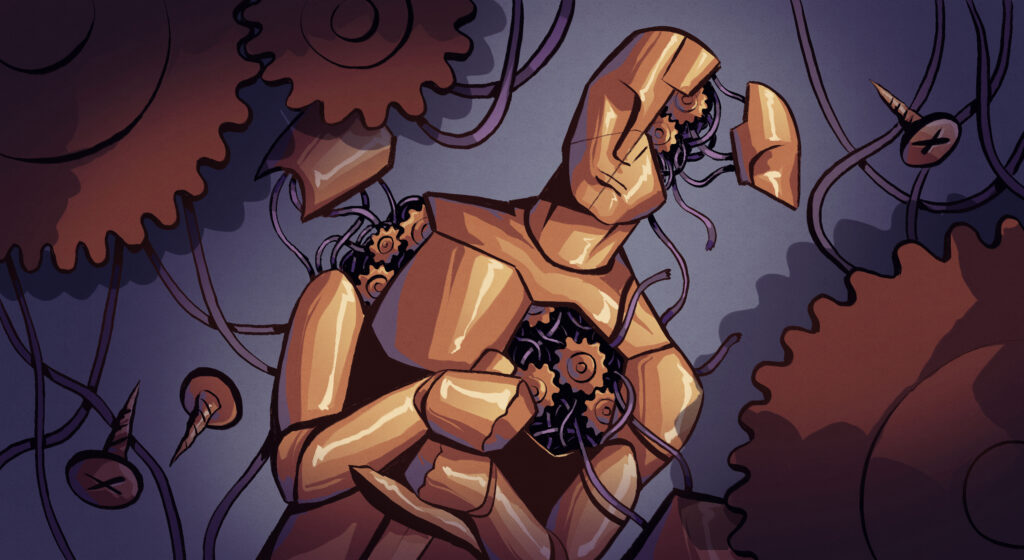
Illustration by Rowan Hansen
On May 1st, 2026, the Academy of Motion Picture Arts and Sciences announced new rules banning the use of AI-generated performances and scripts from Oscar eligibility for the 99th Academy Awards (2027 ceremony). The organization explicitly required that all nominated acting roles be demonstrably performed by humans and that all screenplays be human-authored. The Academy also reserved the right to request proof of human authorship from any film under consideration. This move is a major change from the previous year’s rules, which left it largely up to each branch to decide how much AI involvement was too much.
Why Now?
The timing is not an accident. As AI has advanced and become more intertwined with daily life, Hollywood has questioned what it means for filmmakers. AI actors are already making headlines, like how an AI-generated version of Val Kilmer is being used in an independent film, and an AI “actress” named Tilly Norwood has been stirring debate. AI was also one of the central issues in the 2023 writers’ and actors’ strikes, which Hollywood never resolved. New video generation tools are getting powerful enough to replace creative roles that were once exclusively human. The Academy couldn’t stay neutral forever, especially with their previous statement of how AI “neither helps nor harms” a film’s chances, and the industry made sure to make some noise to get attention on the matter.
The Acting Category
Within the acting category, the new rules state that AI-generated performances are now explicitly banned from eligibility and that roles must be credited in the film’s legal billing. Performances must also be demonstrably performed by a human, with their consent, which is important because it addresses concerns about studios using an actor’s likeness without permission.
Another new rule, not regarding AI, is that actors can now be nominated more than once in the same category if their performances rank in the top five. This is meant to cut down on “category fraud”, where campaigns move a performance from lead to supporting to avoid splitting votes. A good example to reference is Kate Winslet in 2008, who won Golden Globes for both Revolutionary Road and The Reader, but was only submitted for one at the Oscars. An example of this recently is where Paul Mescal had two strong performances in the same year, in The History of Sound and Hamnet, but could only be submitted for one. This update is a statement that the Oscars are still a celebration of human performance.
The Writing Category
Writers also got their own set of protections under the new rules. Screenplays must be entirely human-authored to be eligible, which applies to both original screenplays and adapted screenplays. This is the first time the Academy has explicitly codified this in writing. AI tools have become increasingly common within Hollywood, even among professional screenwriters. The 2023 writers’ strike was largely fought over this exact issue, where writers feared being replaced or forced to work alongside AI. This rule is a direct response to those concerns.
There are some questions raised about this rule by the way it was written. There is no clear answer to how the Academy distinguishes between a writer who used AI as a tool versus one who let it do the heavy lifting. The line between AI assistance and AI authorship is not something the Academy has fully defined. The Academy reserved the right to request proof of human authorship from any film under consideration, but has not explained what that proof would look like. For now, the rule sets a standard without fully explaining how it will be upheld.
What This Means for Filmmakers
For the people who actually make films, these rule changes represent something larger than just an award. With actors now having explicit protection against AI replicas being used without their consent, it gives the actors more leverage when negotiating with studios over the use of their likeness. Their performances are now guaranteed to be judged against other human performances, not AI-generated ones.
For writers, the rules validate what they fought for during the 2023 strikes, which were never fully resolved, and the rules send a message that human storytelling still has value in Hollywood. However, the ambiguity around enforcement means the fight is not entirely over.
For directors and producers, the rules introduce a new layer of responsibility and accountability. Productions that have leaned heavily on AI tools may need to rethink their approach, and filmmakers may find themselves documenting their creative process in ways they never had to before, just in case the Academy comes asking.
Perhaps most importantly, these rules do not ban AI from filmmaking altogether. They simply draw a line around what can and can’t win an award. What happens on set, in the editing room, or in the writing process remains largely up to the industry to figure out on its own.